Sunday, 9 August 2015

Monkey’s Worship Made Shiva ‘Sukreeswara’

Sukreesawarar Temple
Tirupur, which is now popularly called ‘The Dollar city’, accommodates a great number of migrant labourers from various states of the country by providing them job opportunities in its numerous knit-wear units. With its stupendous economic growth (Despite at the cost of its natural environment) in the recent years, Tirupur soon developed into a much-sought after destination for lucrative income.  And it is surprising that the present day knit city, which was once a nondescript village in Palladam Taluk, rose to the heights of a district and brought the latter under it. Nevertheless, few in the modern day Tirupur know the glory of its tiny locality Sarkar Periyapalayam, which, several centuries ago, flourished as a famous trade town.  And the evidence for its historical eminence is available as inscriptions on the walls of the Sukreeswarar Temple.
Though the temple is called ‘Kurakkuthali’ from the lines Kongil, Kurupil, Kurakkuthaliyai…, as the Shaivite poet Sundarar praises it in his literature Tevaram, the history of the shrine is shrouded in myths. Legend has it that the temple got its name as ‘Sukreeswarar Kovil’ after Sugriva, the king of monkeys, who carried a Shiva linga, rested it at a place and relaxed for a while. But, as he could not lift the linga from the place again, it is said he worshipped Lord Shiva there. Hence, like Patteeswara , Magudeeswara and so on, a new Eswara  appeared at Sarkar Periyapalayam as Sukreeswara  !
Throwing light on the trade activities of a large merchant guild at Sarkar Periyapalayam, whose name is mentioned as Mukundhanur in an epigraph, an inscription spread on the entire large wall of the shrine unfolds how the traders planned the expenses to conduct the temple festival Vaikasi Thiruvizha to worship the deity Kurakkuthali Nayanar. Interestingly, expressing their consent, as many as 64 merchants have ‘signed’ their names on the inscription. While four of them have given their signatures in the ancient Vatezhuthu (Rounded script) the rest have done it in Tamil script. The four merchants had hailed from ‘Malaimandalam’ which refers to the present day Kerala.  
Poongundran, former assistant director, Tamil Nadu Archeology Department, says:
“The inscription, which contains both Vatttezhuthu and Tamil scripts, throws light on the gradual development of Tamil orthography in ancient times”  
Taking a history enthusiast to the world of trade in ancient times, the inscription details the names of different commodities and the customs duty on their exports and imports.
Besides, the it also informs the names of the merchants with their native towns as Urayurudayaan Periyyayya Devan, Pandimandalathu Sundarapandiyapurathu Siriyapillai ,  Eralapurathu Vyapari Koothan Kannan and so on. 
Pointing out the mention of the place ‘Eralapuram’ in the inscription, Poongundran informs it is none other than today’s Ernakulam in Kerala!

Source: Kongil Kurakkuthali – Sukreeswarar Kovil – Epigraphist D. Sundaram

Saturday, 1 August 2015

The Kongu Woman who Triggered the Protest against Alcohol

  
Though a treat in wine has become undesirably inevitable even in family functions these days, it is shocking that the 'alcoholic culture' has seen its development even in a school girl's alleged consumption of liquor, which caused her to make flutter in the city some days ago. Adding fuel to the fire, when the news hit the headlines, comments poured into social networks like Facebook and WhatsApp. Interestingly, a commentator remarked that progressive thinkers and feminists should only be happy about the incident misinterpreting women's liberty as nothing but their liberty in consuming liquor on par with men!

Despite the history of consuming liquor dating back to several centuries and proofs on women drinking toddy found in ancient pieces of Tamil literature, consuming liquor in the present day brings harm to both men and women. And no progressive thinker or a feminist can demand equal rights for women in consuming liquor rather than seeking a total ban on it.
While the TASMAC outlets sell Indian Made Foreign Liquor today, the 56th song in Purnanuru, a Sangam period literature informs that the ladies in the palace of the Pandya king served him the 'fragrant cool wine brought in fine ships by the Greeks'. Though the song stands witness to the trade ties between ancient Tamils and Greeks, it throws light on the opulent lives of the Sangam age kings.

It is an old story that the Kongu chieftain Adhiyaman presenting poetess Avvayar a rare species of 'Nellikani' (emblica officinalis) - the fruit believed to provide ailment free longer life. However, a Tamil teacher will be stranded at the very first line of the 235th poem in Purananuru, since Avvayar states in it that Adhiyaman had also offered her toddy to drink!

What's more, noted Tamil writer Perumal Murugan, in one of the chapters from his controversial novel Madhorubhagan, portrays the fiction's hero Kali sharing toddy with her mother, as they discuss a family affair during a calm night.

Though many farmers associations have been demanding to lift the ban on toddy, claiming it as a non-toxicant drink, the total ban on abolishing alcohol, irrespective of it being toddy or IMFL, seems gaining moment with the demise of Gandhian activist Sasi Perumal on Friday. It may be noted that he died during his protest to shift a TASMAC outlet located in the proximity of educational institutions and places of worship at Marthandam in Kanyakumari district.

Several decades ago, in Gandhiji's non-cooperative movement, even women from the Kongu region played a key role in abolishing alcohol by picketing plenty of toddy shops. As the agitation gained momentum, even other Congress leaders Madhan Mohan Malavia and C.Sankaran Nair suggested Gandhiji to give up the protest.

However, Gandhiji is said to have told them thus:

“It is not in my hands. I have to discuss this with two women crusaders against alcohol in Erode”
The one is Nagammal, wife of Periyar E.V. Ramasamy and the other Kannammal, his younger sister!


Sources: 1) Purananuru, 2) Madhorubhagan – Perumal Murugan, 3) Muzhu Madhuvilakku Adhuve Namathu Ilakku – R. Ravikumar

Link to my article in The New Indian Express : http://epaper.newindianexpress.com/555928/The-New-Indian-Express-Coimbatore/02082015#page/3/1

Sunday, 5 July 2015

Arthanareeswara, End this Epidemic Called 'Caste'


Named as Arthanareeswara, Lord Shiva reflects His left part of the body as His consort Parvathi - a symbol for the deity's deep love for His wife and vice versa. As learned from the devotional pieces of literature like Thevaram and Thiruchengottu Puranam, Goddess Parvathi had performed penance in popular holy places like Kedarnath, Kasi, Kanchi and Thiruvannamalai to obtain a boon to become permanently a part of Her husband. And the people of the Kongu region can take pride that the 'holiest' place, where Parvathi could, at last, obtain the boon was Thiruchengode in the Namakkal district.
Mentioned as ' Thirukodimaada Chengundrur' in various pieces of ancient Tamil literature, the town is popular for its Arthanareeswarar Temple, a hill shrine, which inspired many devotional poets to sing paeans on it. Observing an incident from the great Tamil epic Silapathikaram, Arumpatha Urayasiriar, a well-known commentator on the epic, pointed out that its heroine Kannagi came to the hill Neduvel Kundram, which is none other than Thiruchengode, after setting Madurai on fire.
Linking the Lord's relationship with Kongunadu, Arthanareeswarar Kuravanji, another literary work penned by the 17th century Kongu woman poet Poongothai, mentions Shiva and Parvathi of Thiruchengode as 'Kongar Desar' and 'Mohanangi' respectively.
Thiruchengode, which means 'a holy, red, mountain peak' looks like a snake when viewed from the plains. Therefore, it got its other names as 'Nagasalam', 'Nagagiri' and 'Uragagiri'. Celebrated Tamil Bhakthi poet Arunagirinathar, known for his devotional poem Thirupugazh, calls Thiruchengode as 'Nagasalam' in his literary works Kanthar Anuboothi and Kandhar Alangaram.
However, archeologists and historians opine that Thiruchengode was a tribal hill shrine once, since the Naga Vazhipadu or worshipping snakes had been a culture with ancient tribes. They contend that even the carving of the 60 feet 'Aadhisedan' ( chief of the serpents) on the hill shrine is nothing but the remnant of the tribal culture.
The temple at Thiruchengode, besides its popularity in such pieces of literature, recently became a spot of cultural politics after noted Tamil writer Perumal Murugan was hounded by Hindutva and caste outfits, as he had said in his novel Madhorubhagan that childless women of Thiruchengode once indulged in consensual sex at the Arthanareeswarar Temple in order to get conceived.

And for the second time, the shrine's name has hit the headlines of newspapers, after Gokulraj, a Dalit engineering graduate, was abducted when he was with a caste Hindu girl Swathi at Sri Arthanareeswarar temple and later allegedly murdered by a nine-member gang.

It is said that popular Shaivite Tamil poet Thirugnana Sambanthar, while staying in Thiruchengode during a winter season, witnessed all his apostles fell ill and sang a hymn in praise of Lord Arthanareeshwara that made the malady disappear from the entire town.

Nonetheless, the prayer today to the Lord is “ Arthanareeswara, End this Epidemic Called 'Caste'

Waking up the Village Dawn by her Auspicious Music

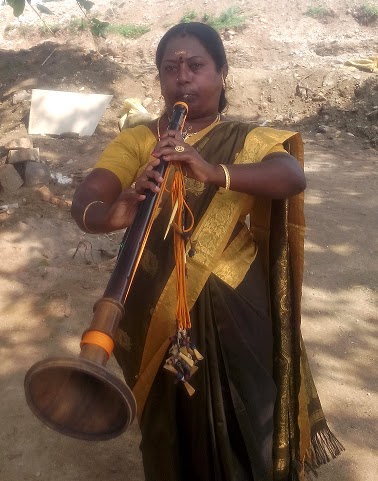
In Tamil Nadu, there are hardly any festivals that begin without the auspicious notes played in the traditional musical instruments Thavil and Nadaswaram. And, blessed is a hamlet near Pollachi, as it wakes up everyday to the auspicious crescendo of Nadaswaram when a woman musician regularly practises playing it in her home early in the morning.
“ Though it is rare for people to come across women playing the Nadaswaram, I don't think gender has anything to do with music” says M.N. Kaleeswari, the 41 year old Nadaswaram artiste.
Clad in her dark green silk saree, she presented her performance in the consecration of her village's Amaneeswarar Temple, which is one of the ancient shrines of Coimbatore.
“ Playing Nadasawaram gives me pleasure and tranquility. And the joy, which I cannot express in words, is something felt only by playing the instrument” avers Kaleeswari.
Hailing from a traditional music family in Pollachi, Kaleeswari studied only up to class VIII. Nevertheless, her father Murugesan, who was a Thavil vidhwan, encouraged her to learn Nadaswaram.
“ My flair for music is something innate, as I was a passionate listener to songs on the radio even while I was a girl. And wherever there was a Cutchery in the agricultural town, my father used to take me with him. Sitting in the front row, I would keenly observe the intricacies in the Nadaswaram music. When I was 10 years old, my father enrolled me as a student under Nanjappa Gopalswamy, a popular Nadaswaram vidwan in Zamin Uthukuli ” she recalls.

The Amaneeswarar Temple at Devanampalayam
Kaleeswari points out that a thorough vocal practice in Sarali Varisai, the fundamentals of Carnatic music, is mandatory for learning Nadaswaram. Reminding the lines of the lyric Eazhu Swarangalukkul Eththanai Paadal..., she notes that all ragas are nowhere but within these seven swaras.


I did my first performance with my teacher at Pollachi, when I was 20 years old. The audience were at a surprise on watching, for the first time, a girl perform the Nadaswaram. However, with my love for the instrumental music, I had little hesitation to present my maiden performance” she reminisces.


Her father Murugesan's passion for the traditional music, can be felt in his making Kaleeswari a Nadaswaram vidwan. He had not worried that he had no sons to continue his line.


What's more, my father also gave me in marriage to Nataraj, a Thavil Vidhwan in Devanampalayam, so that we both could continue our family's music tradition ” she informs.


Sharing her favourite old film songs that she plays in Nadasawaram, Kaleeswari notes:


We play the Mangala Isai ( Auspicious music) in weddings, temple consecrations, ear boring and puberty ceremonies. In a number of weddings, I have enthralled the audience by playing the lyrics that match situations like 'Poomudipal Intha Poonguzhali' during 'Manapen Azhaippu' and 'Olimayamana Ethirkalam En Ullathil Therikirathu' soon after the 'Muhurtham'”


Like her father, Kaleeswari and Nataraj also want their family's music tradition to continue. And they teach it for their nephew, since the couple has no children. 


Saturday, 13 June 2015

Discovering Roots of Vaishnavism in the Sangam Age

Epigraphist D. Sundaram and archeologist R. Poongundran deciphering the stone inscription at the Perumal temple in Vadachitoor

Discovering Roots of Vaishnavism in the Sangam Age

According to the popular story The Tower of Babel in the Old Testament, when human beings wanted to live together and attempted to build a city and a tower reaching up to the heavens, the Lord, by making each of the people speak a different language, prevented them from reaching the heavens. And it is surprising that such a desire of man to link earth with heaven can be seen even at a village Vaishnavite temple in Coimbatore.

The tall pole, which is called Garuda Kambam, erected vertically in front of the temple, is a symbol of man's wish to connect earth with the heavens” explained R.Poongundran, eminent archeologist and former Assistant director of Tamil Nadu Archeology Department.

Poongundran and epigraphist D.Sundaram were recently at a Perumal temple in Vadachittoor near Pollachi for deciphering a few stone inscriptions on the shrine's wall. As the temple is gearing up for the consecration shortly, the villagers invited the duo to decrypt the stone inscriptions and trace the history of the shrine.

As the inscriptions were covered in thick lime-mortar paste for ages, the epigraphists cleaned and deciphered them.

An inscription reads that the Mahamandapa of the shrine was built in the Kali Yuga year 4969. As Kali Yuga begins 3101 years ago, subtracting it from 4969, we arrive at the answer that the shrine was built in 1868. Though it is a Vaishnavite temple with Lord Perumal being its deity, the epigraph notes that the Mahamandapa was built by one 'Kumarasamy Gounden' ” informed Sundaram.

Describing the entry of Vishnu cult in the Kongu region being nothing but the comeback of the social life in Mullai, one of the five Sangam period landscapes, Poongundran explained:

The ancient Tamils of Mullai ( Forests) engaged in the occupation of cattle rearing and worshiped the deity Mayon, who is now identified with Lord Krishna, believed to be an avatar of Vishnu or Perumal”

Deciphering another inscription on the wall of Thayar Sannithi ( The abode of Lakshmi, the Mother Goddess of all creatures protected by Lord Perumal) at the temple, Sundaram noted:

According to an inscription the Thayar Sannithi could have been built by one 'Veeramuthu Mudhali' . The epigraph also states that it was consecrated in 1848 ”

Quoting the lines Kongum, Kudanthayum, Kottiyoorum Engum Thirinthu Vilayadum Enmakan... from Nalayira Divya Prapantham, a collection of 4000 Tamil verses composed by the 12 Vaishnavite Azhwars, Poongundran points out:

Vaishnavism takes its roots from the social life of the ancient Mullai land Tamils. And the movement's popularity is wide in the Kongu region, which is known for its cattle wealth” added Poongundran. 

Link to my article in The New Indian Express : http://epaper.newindianexpress.com/c/5549598